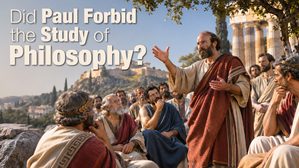
Did Paul Forbid the Study of Philosophy?

Category: Alleged Discrepancies; Colossians 2:8
The skeptic Steve Wells alleged that he had found an absurdity in Colossians 2:8, because the verse states, “Beware lest any man spoil you through philosophy” (KJV).1 The New American Standard Bible (1995) renders the phrase, “See to it that no one takes you captive through philosophy.” At first glance, the passage can be read as an anti-intellectual prohibition of philosophy. Anecdotally, this kind of argument has been posed to me personally. But does the verse make such a prohibition? As is always the case with allegations of some absurdity in the biblical text, the criticism is based on a superficial reading of the passage in question.
Paul’s Specific Warning
First, note that Paul was not warning against philosophy in general but against a certain philosophy that led in a particular direction. Much has been written in an effort to identify precisely the specific set of doctrines which involved the binding of Jewish law and tradition in the Christian age, with elements of Greek thought and mysticism.2 In fact, a reading of the rest of Colossians 2:8 invites us to study just what kind of philosophy posed a threat to the church at Colossae: “See to it that no one takes you captive through philosophy and empty deception, according to the tradition of men, according to the elementary principles of the world, rather than according to Christ” (NASB). For the present article, we need not investigate the details of the heresy that threatened the church at Colossae, but we merely note that it involved specific, false claims that might have seemed attractive to the Christians. Would Paul have condemned the practice of philosophy as such?
What Is Philosophy?
Philosophy literally means “love of wisdom.”3 While it is difficult to give the necessary and sufficient conditions for classifying some activity as philosophical, nonetheless philosophy is widely regarded as the discipline of critical thinking for the purpose of giving reasons for one’s beliefs—especially about perennial questions of human life. Philosophy does not have a particular subject matter but is rather a critical approach to all subjects.4 Consider the following definition:
[P]hilosophy may be defined as the attempt to think rationally and critically about life’s most important questions in order to obtain knowledge and wisdom about them. Philosophy can help someone form a rationally justified, true worldview, that is, an ordered set of propositions that one believes, especially propositions about life’s most important questions.5
It is clear, then, that all people—as rational creatures—do philosophy insofar as they seek to handle evidence in order to justify their beliefs and actions. As DeWeese and Moreland put it, “Everyone has beliefs about what is real, what is valuable, and how we come to know such things. For most people, such fundamental beliefs are largely unexamined and perhaps even mutually inconsistent, but in forming such beliefs and acting on them, everyone is doing philosophy.”6
Biblical Endorsement of the Philosophical Enterprise
With this understanding of philosophy in hand, it is equally clear that the Bible itself requires people to do philosophy—not necessarily to study philosophy officially in school or to believe what any group of philosophers believe, but to pursue belief in what is warranted by the evidence. Roy Deaver pointed out helpfully,
God addresses Himself to the mind of man, and God expects us to be concerned about the evidence. The Bible enjoins: “Prove all things; hold fast that which is good” (1 Thessalonians 5:21). Further, the common notion that “where there is knowledge there can be no faith, and where there is faith there can be no knowledge” is likewise just as false as can be. When the people of Samaria had seen the Lord and had heard Him they declared: “Now we believe…and know that this is indeed the Saviour of the world” (John 4:22)…. Peter commands followers of Jesus Christ to “…give answer to every man that asketh you a reason concerning the hope that is in you…” (1 Peter 3:15). The interested man is asking for a “reason.”7
One cannot reason at all without using the laws of rationality, which are discovered and applied philosophically rather than scientifically.8 Paul himself endorsed the love of wisdom (Colossians 1:9); said that he taught and admonished with wisdom (Colossians 1:28); and said that Christ provides wisdom (Colossians 2:3). Paul marshalled evidence to support his claims (e.g., Acts 17:2-3,16-31; Romans 1:18-23; 1 Corinthians 15:12-19). The evidence supporting the existence of God, the inspiration of the Bible, and the deity of Christ is sufficient to warrant one’s living the Christian life (Romans 10:17; 2 Corinthians 5:7).
Conclusion
Practitioners of any discipline can disagree with God, and such is always wrong. There are many philosophers who opposed God, such as those Paul encountered in Colossae and Athens (Acts 17), but this does not make the entire discipline of philosophy wrong. Paul himself nobly and spiritually practiced the philosophical enterprise by reasoning where the evidence led him—to faithful service for Christ (see Acts 26:1-29).
Endnotes
1 “Colossians Chapter 2” (n.d.), The Skeptic’s Annotated Bible, https://www.skepticsannotatedbible.com/col/2.html.
2 E.g., J.B. Lightfoot (1961 reprint), Saint Paul’s Epistles to the Colossians and to Philemon (Grand Rapids: Zondervan), pp. 73-113; James D.G. Dunn (1996), The Epistles to the Colossians and to Philemon, New International Greek Testament Commentary (Grand Rapids: Eerdmans), pp. 23-34; Ben Witherington III (2007), The Letters to Philemon, the Colossians, and the Ephesians (Grand Rapids: Eerdmans), pp. 164-167.
3 “Philosophy” (2026), Encyclopedia Britannica, https://www.britannica.com/topic/philosophy.
4 See Robert C. Solomon (2012), Introducing Philosophy (Oxford: Oxford University Press), p. 10; J.P. Moreland and William Lane Craig (2003), Philosophical Foundations for a Christian Worldview (Downers Grove: InterVarsity), pp. 12-13.
5 Moreland and Craig, p. 13.
6 Garrett J. DeWeese and J.P. Moreland (2005), Philosophy Made Slightly Less Difficult, second edition (Downers Grove: InterVarsity), p. 2.
7 Foreword to Thomas B. Warren (1982), Logic and the Bible (Ramer: National Christian Press), pp. vii-viii, emp. and parenthetical items in orig.
8 Warren, pp. 20-26.

REPRODUCTION & DISCLAIMERS: We are happy to grant permission for this article to be reproduced in part or in its entirety, as long as our stipulations are observed.