The Durupınar “Ark”: Why a Boat-Shaped Rock Near Ararat Is Not Noah’s Ark


Few claims in popular biblical archaeology have lasted as long as the one about a boat-shaped formation in the hills south of Mount Ararat in eastern Turkey. Known as the Durupınar site, it has been promoted since the late 1970s as the petrified remains of Noah’s Ark. Every few years it returns to the news with new scans, soil tests, and press releases. The story appeals to Christians who believe, as I do, that the Flood account in Genesis records real history. That is exactly why it needs careful scrutiny. When a claim offered as evidence for Scripture fails under examination, every believer who has repeated it as fact is affected.
This article traces how the Ark idea began and how it was later tested. It then looks at what the formation is made of, how real petrified wood is identified, and what evidence would be needed before Durupınar could be called the remains of a wooden boat.
The Site and How It Became Famous
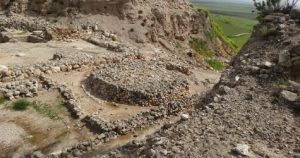
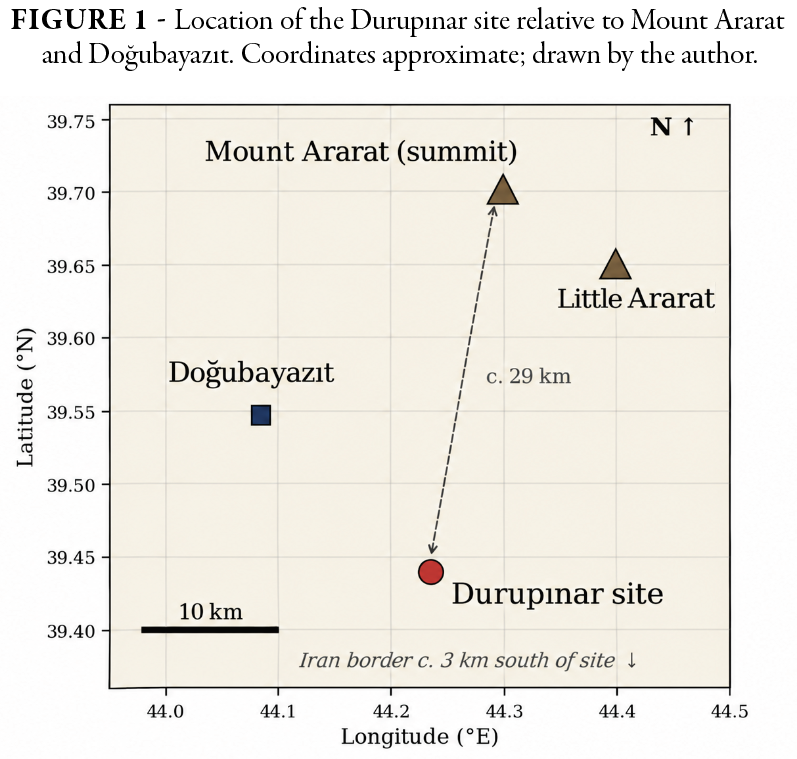
The formation lies about 18 miles (29 km) south of the summit of Mount Ararat (Ağrı Dağı) and about 2 miles (3 km) north of the Iranian border (Figure 1). It is a raised oval about 525 feet (160 meters) long, pointed at one end and rounded at the other, with a low rim that makes it look like a hull from above. It first drew attention in 1959, when a Turkish army captain, İlhan Durupınar, noticed its shape in aerial survey photographs. Life magazine ran a photograph in September 1960 under the headline “Noah’s Ark? Boatlike Form Is Seen near Ararat.”1 Months earlier, in May 1960, an expedition had visited the site, including the evangelist George Vandeman, the aerial-mapping expert Arthur Brandenberger, the Andrews University archaeologist Siegfried Horn, and Captain Durupınar himself. Their trenches found only topsoil and hard clay. Dynamite took them some eight feet deeper, with “still…no trace of archaeological remains.” Vandeman described the formation as “a giant landslide,” and the team concluded that it was “a freak of nature” and that a full-scale excavation “would not be justified.”2
One point should be settled at the outset. Genesis does not say the Ark came to rest on Mount Ararat. It says, “Then the ark rested in the seventh month, the seventeenth day of the month, on the mountains of Ararat” (Genesis 8:4). “Ararat” is the biblical name for the land of Urartu, a region, and “mountains” is plural. The text points to a mountainous region, not a precise landing site. Andrew Snelling of Answers in Genesis has noted that the Durupınar formation sits “in a valley and not on a mountain as described by the Genesis account.” It also rests on volcanic deposits that Snelling, a creationist geologist, believes were laid down after the Flood.3
Ron Wyatt and the Development of the Ark Interpretation
The modern claim that Durupınar is Noah’s Ark is closely tied to Ronald Eldon Wyatt (1933-1999), an American nurse anesthetist and Seventh-day Adventist who became deeply interested in biblical archaeology. Beginning in the 1970s he gave a great deal of time and his own money to investigating sites he believed held physical evidence of biblical events. Durupınar remains one of the best known.4 Wyatt was not a trained archaeologist or geologist. That does not by itself make him wrong, since amateurs have made real discoveries. It does mean that his geological and archaeological claims need to be checked by specialists in those fields.
Wyatt did not discover the formation. He learned of it through the 1960 Life report and became convinced that it deserved further study. Beginning in 1977, he made repeated trips to eastern Turkey and eventually worked with David Fasold and others to build the case that the formation was the mineralized remains, or rock cast, of Noah’s Ark.
His case rested on several lines of evidence. He pointed to the formation’s ship-like outline and its length, which he took to match the three hundred cubits of Genesis 6:15. He read lines within it as the ship’s frame, linked metal-detector readings to iron fittings, called certain material petrified wood, and saw large stones with holes in them as ancient anchors. He and his associates later read radar surveys as showing the remains of a vessel underground.5 None of this was unreasonable to investigate. The question is whether later testing confirmed it.
Wyatt also claimed to have found the site of the Red Sea crossing, the true Mount Sinai, evidence of Sodom and Gomorrah, and the Ark of the Covenant. These claims drew popular attention, but none were ever established through peer-reviewed archaeological publication.6 Still, Durupınar should stand or fall on the evidence found there.
David Fasold: From Advocate To Critic
One of the most important figures here is David Fasold, because he began as a supporter. He worked closely with Wyatt in the 1980s and published The Ark of Noah (1988), arguing that the formation was the biblical vessel.7 After further fieldwork, including a 1994 visit to the site, Fasold changed his mind and concluded that the evidence was geological. He then joined the geologist Lorence Collins of California State University, Northridge, in a detailed study of the site’s rocks and structure.
Their 1996 paper in the Journal of Geoscience Education reports what the microscope and the laboratory showed. The supposed iron bracket was weathered volcanic minerals. The metal-detector “lines” were natural streaks of limonite (a rusty, weathered iron mineral) and magnetite (a naturally magnetic iron mineral). The supposed petrified timber was peridotite, a dark rock from deep within the earth, partly altered by water. The anchor stones were andesite, a volcanic rock found locally.8 These results are taken up in more detail below.
Criticism from Fellow Believers
Rejection of Wyatt’s claim has not been limited to secular critics or to those who doubt the Flood. David Merling, associate director of the Institute of Archaeology at Andrews University and, like Wyatt, a Seventh-day Adventist, wrote as a fellow believer: “Nothing would please me more than knowing that Noah’s ark had been found.” After reviewing the evidence, including the formation’s width of some 138 feet against the 86 feet one would expect from Genesis, and the likelihood that the “anchor stones” were pagan monuments, he concluded that “Noah’s ark has not yet been discovered.”9 The creationist geologists Andrew Snelling of Answers in Genesis and John Morris of the Institute for Creation Research, reached the same conclusion on geological grounds.10 Their verdict carries special weight because they accept the Genesis Flood as history.
Wyatt’s sincerity is a separate matter. He plainly believed in the site and spent years promoting it. Nor should Durupınar be rejected simply because Wyatt promoted it. It should be judged by what it is made of and what lies beneath the surface.
What the Formation Is Made Of
Geologists on both sides of the creation debate have examined the site, and they agree on the basics. Collins and Fasold report that parts of the structure “are pyroxene-bearing andesite or basalt partly altered to serpentine.”11 In plain terms, these are andesite and basalt, two common volcanic rocks, partly altered to serpentine, a greenish mineral that forms when certain iron- and magnesium-rich rocks react with water. Morris notes that “the material within the formation is also equivalent to that in the surrounding hillsides.”12 The rock inside the “ark” is the same rock as the hills around it, which includes igneous ophiolite, limestone, and sandstone.13
Popular accounts of the site often mention feldspar, so it helps to say what it is. Feldspar is the most common group of minerals in the earth’s crust and a main ingredient of volcanic rocks such as basalt and andesite. It has nothing to do with petrified wood. Finding it at Durupınar is exactly what one would expect, since the whole region is volcanic. The real question is whether any sample shows that it was once wood.
How the Boat Shape Forms
The boat shape has a natural explanation. When a mass of mud or landslide debris moves downhill past a knob of harder rock, it piles up against the obstacle and tapers off behind it. The result is a streamlined mound with one blunt end and one pointed end, much as water shapes sand around a stone in a creek (Figure 2A). Morris describes the site in exactly these terms.14 Collins and Fasold first explained the structure as a syncline, a trough-shaped fold in layered rock, worn down by erosion. Collins later emphasized landslide debris from the slopes above, wrapped around a core of hard volcanic rock.15 The Turkish geological engineer Eşref Atabey of Turkey’s General Directorate of Mineral Research and Exploration has also described the structure as the product of a landslide.16
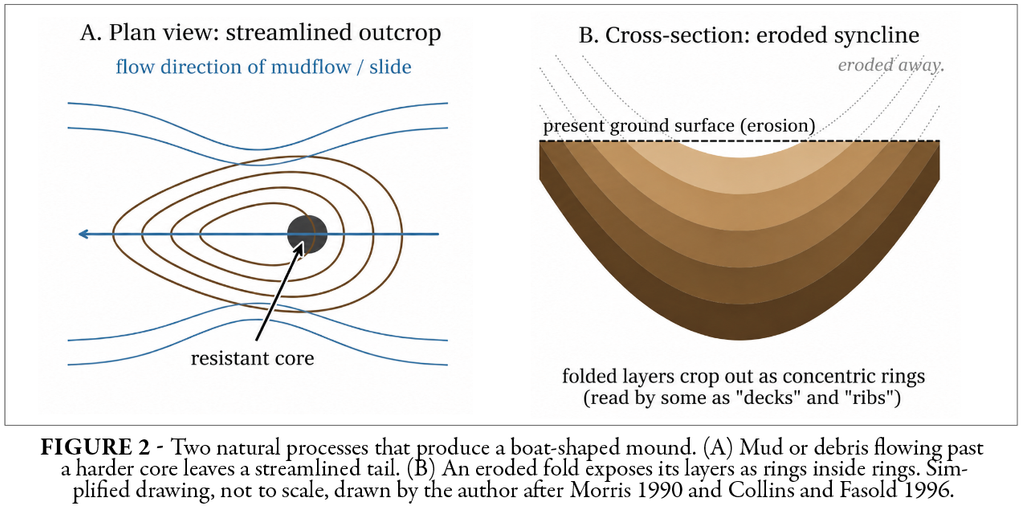
The syncline explanation shows how easily the eye can be fooled from the air. When layered rock is bent into a trough and the top is later worn away, the harder layers show at the surface as rings inside rings (Figure 2B). From above, those bands can look very much like the outline of a hull. Nothing has to be built to produce them. The “walls,” “ribs,” and outlines that Wyatt read as the decks of a ship can simply be the exposed edges of folded rock. The syncline and the landslide are two different explanations, and geologists may weigh them differently. Either one can produce a boat shape without a boat.
Boat Shapes in Nature
Shape alone cannot identify a geological structure. Folded rock, uneven erosion, landslides, and mudflows can all produce surprisingly regular forms, including ovals, streamlined ridges, and mounds pointed at one end. What decides the question is how the structure formed and what lies inside it. How it looks in an aerial photograph settles nothing.
The best comparisons are close at hand. Other long ridges of the same rock can be seen in the land around Durupınar.17 They do not prove exactly how Durupınar formed, but they show that the local geology can produce orderly-looking landforms without anyone building them.
It is still possible that a boat lies buried inside a natural formation, and that possibility can be tested. If a large wooden vessel had been buried by later mud or landslides, careful drilling and digging should find it: the structure of wood, repeated building parts, manufactured materials, or a clear boundary between the boat and the surrounding rock.
Beneath the Surface
Some of the early work used methods that cannot be tested at all. Much of the metal-detector case rested on a “molecular frequency generator,” a device that, as Snelling showed, works on no known scientific principle and functions like a pair of divining rods. Morris compared its use to water-witching.18
Below ground, the evidence points the same way. A ground-penetrating radar survey in 1987 showed a shallow, flat layer, most likely bedrock, and none of the hull and walls Wyatt described. The radar specialist whose name Wyatt cited, Tom Fenner of Geophysical Survey Systems, wrote that he was “surprised and dismayed” to learn it was being used to support the claim.19 Drilling in 1988 struck basalt about 20 feet (six to seven meters) down, the same kind of rock found in the surrounding hills.20
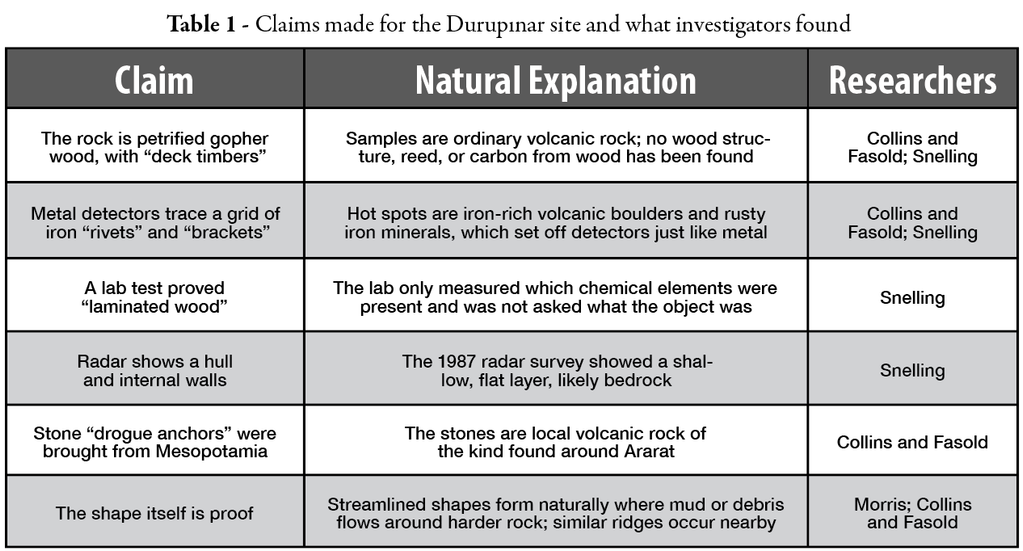
Each of the physical “proofs” offered for the Ark has been examined and found to be natural (Table 1). The supposed iron brackets are grains of limonite set in clay and other common minerals. As Collins and Fasold point out, “both magnetite and goethite cause a metal detector to buzz just like elemental iron.”21 The “petrified wood” is volcanic rock, and the laboratory that analyzed Wyatt’s best-known sample confirmed that it was never asked to say what the object was.22 The large stones with holes that Wyatt called anchors are made of local volcanic rock of a kind almost absent in Mesopotamia, where he said they came from.23 Collins and Fasold sum up: “no fossilized wood or traces of elemental carbon, wood, or reed fragments have ever been found.”24
What Would Petrified Wood Look Like?
Petrified wood cannot be identified just by finding carbon or silica. What identifies it is the structure of the wood itself. As wood petrifies, two things happen. In permineralization, minerals fill the wood’s open spaces. In replacement, minerals take the place of the wood itself. George Mustoe has shown that the two go on together, and that how much of the wood’s structure survives “depends on the relative rates of mineral precipitation and tissue destruction.”25 Even when little of the original wood is left, the minerals often copy its cell walls, the hollow spaces inside the cells, and the tiny tubes that carried water through the tree. Mustoe’s paper shows these features in real specimens under a scanning electron microscope, which can show detail far smaller than the width of a human hair.26
That is why real petrified wood is studied under the microscope. In a study of petrified wood from Denmark, thin slices showed that quartz had coated the cell walls and preserved their shape.27 A 2019 study of samples from Italy, Poland, and South Africa traced “both the structure of cell walls and the remains of ancient organic matter.”28 Until samples from Durupınar consistently show this kind of structure, calling a hard layer “petrified wood” is premature.
The Recent Claims, 2021-2026
Interest in the site revived in 2021, when a team from Ağrı İbrahim Çeçen University and Istanbul Technical University, working with American researchers, collected about thirty soil and rock samples. News reports in 2024 said the samples dated to 3,500-5,000 years ago and contained clay and marine material.29 In January 2026, researchers reported pottery fragments found near the formation.30 Within a biblical chronology that places the Flood around 3300-3200 B.C.,31 these remains belong to the region’s post-Flood history. In August 2026, the American group Noah’s Ark Scans announced 3D radar results showing “angular structures” and a “central corridor,” along with soil inside the formation that held about three times as much organic material as soil outside it.32 In September 2026, drilling led by Professor Cenker Atila of Sivas Cumhuriyet University struck a layer 13 to 16 feet (four to five meters) down that was so hard the drill bit broke. The team’s press release suggested that “petrified or highly mineralized wood are both a possibility.”33
None of these results has been published in a peer-reviewed journal. The drilling results were announced by press release, and the laboratory work was still pending at the time of writing.34 A soil date may tell us when the soil or the organic matter in it formed, not when a boat was built. Marine material is expected in a region whose rocks include limestone, which forms from shells and sea sediments.
A Hard Layer Is Not Proof of Wood
Many ordinary rocks are hard enough to stop a drill, and earlier drilling at the site had already reached rock not far below the surface.35 What matters is what the material is. A core sample can be cut, examined, and tested. Until a core is recovered, documented, analyzed, and reported by independent experts, the fact that it broke a drill bit cannot tell petrified timber from ordinary bedrock.
Carbon Is Not Wood
Carbon readings call for the same caution. Carbon is everywhere near the earth’s surface. Some of it comes from living things, such as roots, microbes, and plant matter carried down by groundwater. Some is locked in minerals such as limestone. The recent reports concern the first kind, organic carbon, and ordinary soil is full of it. A hollow in the land that holds water, mud, and plants could easily build up more organic material than the slopes around it. Finding carbon, or even more organic carbon inside the formation than outside it, cannot by itself show that the material was once timber.
Wood is more than something that contains carbon. It is a living material with a structure. If the formation holds petrified timber, properly collected cores should show cell walls, water-carrying tubes, or other telltale features of wood. That is why scientists who study real petrified wood rely on microscopes and mineral tests and not on chemistry alone.36 Radar images, as Snelling has put it, are “ultimately subject to interpretation based on the bias of the interpreter.”37 Even Ken Ham of Answers in Genesis has faulted the team for being convinced of what the site was before the data were weighed.38
What Evidence Would Change the Conclusion?
It is fair to ask what would change my mind. The claim can be tested. If a huge timber structure is there, cores drilled at recorded spots inside the formation should show wood structure repeatedly, and cores from outside it should not. The samples should be handled so they cannot be mixed up or contaminated, and ideally the laboratories should not be told which ones are supposed to be wood. Thin slices under the microscope should show copied cell structure, and the results should be repeated by independent laboratories and published where other specialists can check them. Cores made entirely of volcanic rock, sediment, and soil, with no wood structure, would confirm the geological explanation. That standard is fair to both sides.
Conclusion
The Durupınar formation is an interesting piece of geology, and the region around it has a real archaeological history. Whether the formation is Noah’s Ark should be decided by the physical evidence, not by the reputation of those who have promoted or criticized it. So far, each of the older claims that has been tested, from petrified timber, metal fittings, and internal walls to anchor stones and the ship-like shape itself, has failed independent geological examination. Recent radar and drilling announcements have raised new questions, but they have not yet produced independently verified evidence of a wooden vessel. The evidence we have is better explained by natural processes.
Christians do not need this site. The truth of Genesis does not depend on finding the Ark, and Snelling reasonably suggests that Noah’s family, with no mature trees left to build shelters, may well have taken the Ark apart for timber.39 If peer-reviewed results ever show wood structure inside the formation, they should be weighed on their merits. Until then, ministers, teachers, and apologists should not use Durupınar as evidence for the Bible. The apostle’s instruction applies here as well as anywhere: “Test all things; hold fast what is good” (1 Thessalonians 5:21).
Endnotes
1 “Noah’s Ark? Boatlike Form Is Seen near Ararat” (1960), Life, September 5, 49[10]:112-114.
2 George Vandeman (1999), “1960-1968 George Vandeman,” in The Explorers of Ararat and the Search for Noah’s Ark, ed. B. J. Corbin (Long Beach, CA: Great Commission Illustrated Books), pp. 230-231.
3 Michael Gryboski (2021), “Answers in Genesis Skeptical of Researchers’ Claims Noah’s Ark May Have Been Found in Turkey,” Christian Post, October 12, quoting Andrew A. Snelling, https://www.christianpost.com/world/answers-in-genesis-skeptical-about-noahs-ark-discovery-claim.html.
4 Andrew Lawler (2021), Under Jerusalem: The Buried History of the World’s Most Contested City (New York: Doubleday), pp. 181-186.
5 Andrew A. Snelling (1992), “Special Report: Amazing ‘Ark’ Exposé,” Creation, 14[4]:26-38, summarizes these claims point by point.
6 Lawler, pp. 181-186. Wyatt dug underground cavities at the Garden Tomb in Jerusalem in the 1980s. After his death, Wyatt Archaeological Research helped fund excavations there by the Israel Antiquities Authority under professional supervision. The published report records the earlier cavities and the remains found, but reports neither the Ark of the Covenant nor anything supporting Wyatt’s claims about it. See Yehiel Zelinger (2006), “Jerusalem, the Garden Tomb,” Hadashot Arkheologiyot, p. 118, https://hadashot.iaa.org.il/report_detail_eng.aspx?id=327.
7 David Fasold (1988), The Ark of Noah (New York: Wynwood).
8 Lorence G. Collins and David F. Fasold (1996), “Bogus ‘Noah’s Ark’ from Turkey Exposed as a Common Geologic Structure,” Journal of Geoscience Education, 44[4]:439-444, https://doi.org/10.5408/1089-9995-44.4.439.
9 David Merling (1993), “Has Noah’s Ark Been Found?—1,” Adventist Review, pp. 13-15 (pp. 517-519 in the volume pagination).
10 Snelling, pp. 26-38; John D. Morris (1990), “That Boat-Shaped Rock…Is It Noah’s Ark?” Creation, 12[4]:16-19.
11 Collins and Fasold, pp. 439-444.
12 Morris, pp. 16-19.
13 Murat Avci (2007), “‘Noah’sArk’: Its Relationship to the Teçeker Earthflow, Mount Ararat, Eastern Turkey,” Bulletin of Engineering Geology and the Environment, 66:378.
14 Morris, pp. 16-19.
15 Collins and Fasold, pp. 439-444, and the postscript to the online version, https://www.csun.edu/~vcgeo005/bogus.html.
16 Eşref Atabey (2025), “Noah’s Ark, a Geological Structure Formed by Landslide Effect” (Ankara: General Directorate of Mineral Research and Exploration).
17 Collins and Fasold, pp. 439-444.
18 Snelling, pp. 26-38; Morris, pp. 16-19.
19 Snelling, pp. 26-38.
20 Snelling, pp. 26-38; Morris, pp. 16-19.
21 Collins and Fasold, pp. 439-444; Snelling, pp. 26-38.
22 Snelling, pp. 26-38.
23 Collins and Fasold, pp. 439-444.
24 Ibid., pp. 439-444.
25 George E. Mustoe (2017), “Wood Petrifaction: A New View of Permineralization and Replacement,” Geosciences, 7[4]:119, https://doi.org/10.3390/geosciences7040119.
26 Mustoe, p. 119.
27 Rikke Weibel (1996), “Petrified Wood from an Unconsolidated Sediment, Voervadsbro, Denmark,” Sedimentary Geology, 101[1-2]:31-41.
28 Andrzej Kuczumow, et al. (2019), “Analysis of the Composition and Minerals Diagrams Determination of Petrified Wood,” Microchemical Journal, 148:120-129.
29 “Discovery Reignites Search for Noah’s Ark in Turkey’s Mountains” (2024), Jerusalem Post, https://www.jpost.com/archaeology/article-825786.
30 Shir Perets (2026), “Pottery Found in Turkey Sparks Debate over Noah’s Ark Site,” Jerusalem Post, https://www.jpost.com/archaeology/article-881983. Professor Kaya gave the pottery conventional dates of 5500-3000 B.C., which archaeologists assign to the Chalcolithic, or “Copper Age”; those dates do not fit the biblical timeline, and the pottery is a remnant of the post-Flood era.
31 This date follows the chronology of the Septuagint (LXX), the Greek translation of the Old Testament, which gives longer ages for the patriarchs in Genesis 5 and 11 than the standard Hebrew (Masoretic) text. For the textual case behind this date, see Henry B. Smith Jr. (2018), “The Case for the Septuagint’s Chronology in Genesis 5 and 11,” in Proceedings of the Eighth International Conference on Creationism, ed. J. H. Whitmore (Pittsburgh, PA: Creation Science Fellowship), pp. 117-132; Henry B. Smith Jr. (2017), “Methuselah’s Begetting Age in Genesis 5:25 and the Primeval Chronology of the Septuagint,” Answers Research Journal, 10:169-179; Justin Rogers (2020), “Can I Trust the Numbers of Genesis 5?” Reason & Revelation, 40[8]:86-89.
32 Assaf Golan (2026), “Did Researchers Just Find Noah’s Ark? 3D Radar Scan Reveals Hidden Turkey Structures,” Israel Hayom, https://www.israelhayom.com/2026/08/24/noahs-ark-radar-scan-turkey-mount-ararat/.
33 Noah’s Ark Scans (2026), “Core Drilling Begins at Durupinar Noah’s Ark Site, Drill Bit Shatters on Possible Layer of Petrified Wood,” press release, GlobeNewswire, https://www.globenewswire.com/news-release/2026/09/23/3367545/0/en/.
34 Christopher Plain (2026), “New Drilling at Controversial ‘Noah’s Ark’ Site Reveals Organic Material and Mysterious Underground Cavities,” The Debrief, https://thedebrief.org/new-drilling-at-controversial-noahs-ark-site-reveals-organic-material-and-mysterious-underground-cavities/.
35 Snelling, pp. 26-38; Morris, pp. 16-19.
36 Kuczumow, pp. 120-129; Mustoe, p. 119.
37 Snelling, quoted in Gryboski.
38 Plain, “New Drilling.”
39 Snelling, quoted in Gryboski.

REPRODUCTION & DISCLAIMERS: We are happy to grant permission for this article to be reproduced in part or in its entirety, as long as our stipulations are observed.