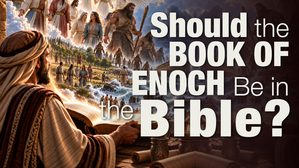
The Book of Enoch in the Ethiopian Bible: A Test Case in Canonicity


In the past, it was newspaper headlines and news outlets that provided the public with provocative stories about mysterious archaeological finds, conspiracy theories, and odd historical events. Today, it’s YouTube videos, podcasts, and social media shorts. The reader is probably aware of the amount of Internet content about these captivating topics. One such subject that has gained much attention on the Internet is the mysterious Book of Enoch. Claims are often made that this book was “taken out of your Bible” or that it expounds “the truth” of mysterious stories from other parts of the Bible. Facebook posts, podcast episodes from Joe Rogan and Shawn Ryan, and even popular-level books like The Book of Enoch by Timothy Alberino, a self-proclaimed author/lecturer/explorer, have all played a role in making the Book of Enoch trendy. Foremost of all is the alleged online claim that the oldest known Bible, the Ethiopian Bible, includes the Book of Enoch. Because of this, many claim the Ethiopian Church preserves a canonical book that was stripped from everyone else’s Bible for political or economic reasons. Are the claims true, however? Did the Book of Enoch get pulled from the Bible? Does the Ethiopian Church preserve an additional inspired book? What even is the Book of Enoch? These questions will be explored in search of the truth. In the end, by analyzing the Book of Enoch closely, it will become clear that the online claims made about its divine inspiration are false.
What Is the Book of Enoch?
First, the Book of Enoch must be identified and understood. Although the document called the Book of Enoch is regularly cited online, it is a bit of a misnomer. There is not one Book of Enoch; there are three. First Enoch—sometimes called the Ethiopic Apocalypse of Enoch—is usually what people talk about; 2 & 3 Enoch are obscure and seldom discussed. Furthermore, the entirety of 1 Enoch is rarely in view. Most people only focus on a single portion of 1 Enoch, called the Book of the Watchers, due to its fascinating content.
The content of 1 Enoch is rather obscure. It is classified as Jewish apocalyptic literature.1 Most scholars break it into five different booklets, each of which has its own unique material. It has a section of parables (chs. 37-71), a treatise on calendar disputes (chs. 72-82), dreams about future human history (chs. 83-90), and a personal testament of Enoch, which includes the Apocalypse of Weeks (chs. 91-107). The most popular portion of 1 Enoch, as stated earlier, is the Book of the Watchers (chs. 1-36). This narrative portion concerns fallen angels (called “watchers,” as in Daniel 4:13), the corruption of mankind, and Enoch’s unsuccessful attempt to intervene. This section is an expansion and interpretation of the mysterious content in Genesis 6:1-4 about the “sons of God,” “daughters of men,” and “Nephilim.” This biblical passage is indeed difficult to interpret.2 Even James VanderKam, a renowned Old Testament scholar, once noted: “A reader who is confused by the paragraph [Genesis 6:1-4] may take comfort from the fact that the commentators are as well.”3 First Enoch depicts an antediluvian rebellion in Genesis 6 which consisted of angels mating with human women to produce gigantic offspring.4 Subsequently, the world experienced great turmoil and destruction due to these giants. As it now stands, “this idea that the sons of God were angels is the earliest interpretation we have for Genesis 6:1.”5 People often use the antiquity of this interpretation to attribute unexplainable things to the gigantic offspring of humans and angels, like the origin of the Egyptian Pyramids.
The Bible records that Enoch was the seventh man from Adam, the great-grandfather of Noah (Genesis 5:21,25,28-29). However, according to Genesis 5:24, Enoch never died, or rather, “he was not, for God took him.” As a result of this abrupt ending to Enoch’s life, a body of literature emerged that sought to fill in the gaps for his life. Ephraim Isaac described this ancient practice as follows:
This tradition of Enoch’s spiritual relocation gave rise to many haggadic [interpretive—AS] stories, including one that Enoch, son of Jared, when he was taken away by God, saw the secrets of the mysteries of the universe, the future of the world, and the predetermined course of human history.6
This quote is representative of how 1 Enoch is viewed in the scholarly community: as an expansion on mysterious details in the Bible. Other examples of this practice include the apocryphal additions to Esther and Daniel, which expand the biblical accounts with imaginary details. Thus, it is well established within the field of biblical studies that ancient documents sometimes expanded biblical material. However, due to glaring differences, there are almost no grounds to argue that these additions demand the same status as the biblical texts (see below for more details).
Furthermore, even though this work is named after the biblical character of Genesis 5, the claim that Enoch wrote the books which bear his name is impossible to defend. For one, Jewish sources claim Moses was the first person to write any Scripture—thus precluding Enoch.7 Furthermore, how could any written prophecy survive the global Flood? Although one might argue that Enoch’s prophecies survived only orally until 1 Enoch was written, neither biblical nor secular evidence for this claim exists.8 For these reasons, the Enochic literature is classified as Old Testament pseudepigrapha. The pseudepigrapha are described as a “large number of spurious religious writings which circulated in the ancient Jewish community.”9 The “spurious” nature of the pseudepigrapha is not because of their content, per se, although these works do make false claims. Rather, they are spurious in their genuineness. The term “pseudepigrapha” loosely means “false writings,” just as the term “pseudonym” means “false name.” In other words, these works were written under the name of a biblical character but were not written by that biblical character.10 Although rather influential, the Old Testament pseudepigrapha were not viewed as Scripture by ancient Jews. With an understanding of 1 Enoch, we may now explore whether this apocalyptic, pseudepigraphic work is canonical.
Should 1 Enoch Be In the Bible?
Not just any book is Scripture. Just because a book is old and records material analogous to the Bible does not make it God’s Word. There are certain marks of canonicity. Such qualities are “determined by God and discovered by man.”11 God determines a book’s canonicity by His inspiration. The result of a book’s inspired quality is that God’s people accept it for what it is—His Word. Such was the case when Israel responded to the “Book of the Covenant” (Exodus 24:7), when Judah responded to Josiah’s reading of the lost Law (2 Kings 23:3), and when the returned exiles cried and responded to Ezra reading the Law (Nehemiah 8:14-17). In the subsequent centuries following a book’s original penning, a few principles were employed to discover whether a book bore the marks of God’s inspiration. Although not a check list, the following are usually employed: authorship, a message which conforms to other inspired works, and reception by the community of God’s people. It must be restated that these man-made criteria do not determine a book’s canonical status; rather, they aid believers in discovering whether a book is from God. Scripture itself bears witness to these criteria, for God spoke a consistent message (John 17:17) through His prophets (Hebrews 1:1), which His people then received and believed (1 Thessalonians 2:13). Accordingly, does 1 Enoch exhibit any qualities that would suggest it should be in the Bible alongside Genesis or Jeremiah?
The Marks of 1 Enoch
As previously noted, 1 Enoch is part of the Old Testament pseudepigrapha. Analyzing the document’s history further illuminates whether such a designation is warranted. First, the manuscript evidence of 1 Enoch is rather revealing. The surviving manuscripts of 1 Enoch come to us in four languages: Aramaic, Ethiopic, Greek, and Latin. The Ethiopic, Greek, and Latin manuscripts all date to centuries after Christ. Such late-dated evidence cannot be used to determine the early history of the document nor whether it is inspired, which points us to the oldest manuscripts of 1 Enoch. There were 11 Aramaic manuscripts of 1 Enoch found among the Dead Sea Scrolls at Qumran. These manuscripts are very fragmentary, meaning they are rather damaged and difficult to read. It was determined, however, that they bore witness to four of the five booklets of 1 Enoch. These manuscripts date to between the second and first centuries B.C.12 Furthermore, 1 Enoch as it is today, 108 continuous chapters, was not uncovered at Qumran. Instead, the Aramaic manuscripts only preserved individual sections. For example, the Book of the Watchers was preserved in one fragmentary manuscript, while the astronomical (calendar) material survives in another, and so on for the other booklets. In addition, the various Qumran booklets all date to different periods. The fact that the 1 Enoch manuscripts at Qumran are not preserved in a single manuscript and date to different periods makes it unlikely that at Qumran 1 Enoch was a unified book like it is today. This fact is unfavorable to 1 Enoch’s case, especially since a whole biblical book which had long been thought to be compositional was preserved at Qumran in a single manuscript (e.g., all 66 chapters of Isaiah in the Great Isaiah Scroll). The oldest surviving complete manuscript of 1 Enoch, however, is dated to the fifteenth century A.D. in the Ethiopic language of Ge’ez, which includes additional material not found at Qumran. Scholars therefore reason that the various booklets of 1 Enoch were originally independent works by different authors that were later compiled into one document.
Unlike the inspired books, whose earliest manuscript evidence generally shows them to be literary wholes, 1 Enoch’s manuscript history witnesses to independent compositions later gathered into what they are today. It is true that the textual history of 1 Enoch reveals it to be an ancient Jewish work. However, the age of a book does not determine if it is inspired and canonical (cf. The Book of Jashar—Joshua 10:13). Although parts of 1 Enoch are old, the manuscript history cannot be overlooked, which reveals its compositional nature.13 Therefore, 1 Enoch cannot reasonably be the work of the pre-Flood Enoch. If so, it falls short of exhibiting prophetic authorship. A work which falsely claims divine prophetic authorship cannot bear the marks of inspiration.
Second, the content of 1 Enoch is telling. Since God does not lie (Titus 1:2), deny Himself (2 Timothy 2:13), nor is He the author of confusion (1 Corinthians 14:33), “we would expect any document purporting to be the word of God to be consistent with other revelation from God.”14 In some cases, such a test is difficult to be definitively administered. This is so because certain pseudonymous books do not present novel doctrine and are generally in spiritual agreement with canonical works (e.g., Psalm 151). When this is the case, other marks of inspiration carry more weight. However, on a few key details, 1 Enoch attributes origins to things which differ from Scripture. For example, 1 Enoch attributes the origin of human sin chiefly to a fallen angel who corrupted mankind (10.8). Scripture, however, teaches that sin entered the world through Adam’s transgression, never attributing the origin of sin to fallen angels (Romans 5:12). Genesis 6 is chronologically after Genesis 3; therefore, the fallen angels of Genesis 6 (according to 1 Enoch’s interpretation) come after sin was already introduced into the world through Adam.
Another chronological problem arises from 1 Enoch attributing the development of human civilization to heavenly wisdom from fallen angels (ch. 8; cf. 9.6). The Bible notes that civilization grew due to humans prior to the events of Genesis 6 (cf. Genesis 4:20-22). Such examples reveal differing historical explanations. If 1 Enoch were inspired, we would expect harmony, not competing explanations. In addition, such lack of harmony is characteristic of the non-inspired, pseudepigraphic Jewish literature of this time. Even if one claimed this disunity does not convincingly display contradiction, the cumulative case against 1 Enoch’s divine quality is overwhelming.
Third, the reception history of 1 Enoch further illuminates the matter. Whether God’s people received a book as inspired by itself does not determine a work’s canonical status, but it is an important step in the process. Remember, God is the initial cause of a book, which determines its inspiration and authority. His people then submit to the books that bear His imprints. This process of gradually submitting to works discovered to bear divine qualities is known as the process of canonization. Although a work was canonical immediately after it was penned, it may have taken longer for God’s people to submit to it. This principle is seen in Scripture when Ahab refused to accept the legitimacy of God’s prophecy (cf. 1 Kings 22:1-38). Although time and space do not allow for a full treatment of the development of the canon of the Old Testament, it suffices to say that 1 Enoch was almost unanimously rejected as Jewish Scripture. Elsewhere it has been convincingly demonstrated that the Jewish canon of Scripture is preserved in the Christian Old Testament, which excludes 1 Enoch.15 In addition, when characters in early church history showed veneration of 1 Enoch, the tide quickly shifted to a rejection of its canonicity. The church father Origen’s comments on 1 Enoch are representative of the early church’s view: “those books [of Enoch] do not seem to be considered authoritative among the Hebrews,”16 and “in the churches the books bearing the name of Enoch are not by any means in circulation as divine.”17 Thus, it cannot be demonstrated that early Judaism or Christianity regarded 1 Enoch as inspired Scripture. Although the authority of a biblical book is not dependent upon its acceptance by Jews and Christians, the general rejection of 1 Enoch cannot be overlooked.
One may very well cite the presence of the 1 Enoch booklets at Qumran—a Jewish settlement—as reason to reject this claim. However, it is important to remember that the presence of a book at Qumran did not determine its scriptural authority. As a matter of fact, there was more extrabiblical literature unearthed in the discoveries by the Dead Sea than biblical works. All that can be said about the presence of 1 Enoch at Qumran is that the community had copies of it, not that it was canonical. Qumran was not the authority in ancient Judaism for the canon of Scripture.18 Furthermore, a case can be made on paleographic grounds that the community lost interest in the Enochic literature. To say that 1 Enoch should be considered Scripture because a single Jewish community had a few copies of it would be like saying Apologetics Press believes Mere Christianity is God-breathed because we have a copy of it in our library. Such a claim is untenable.
When tracing the textual history of 1 Enoch, analyzing its contents, and investigating its reception, it becomes clear that this work does not bear the marks of inspiration. Therefore, if uninspired, it should not be in the Bible.
Objections
Two main objections to the above observations demand our attention: Jude seems to quote 1 Enoch, and the Ethiopian Bible includes 1 Enoch in its canon. These two objections will now be addressed.
Although it is possible that Jude referenced the Book of the Watchers in vs. 6,19 our attention will mainly focus on Jude 14-15, which reads:
Now Enoch, the seventh from Adam, prophesied about these men also, saying, “Behold, the Lord comes with ten thousands of His saints, to execute judgment on all, to convict all who are ungodly among them of all their ungodly deeds which they have committed in an ungodly way, and of all the harsh things which ungodly sinners have spoken against Him.”
This, for sure, is a quotation of something. Genesis never says that Enoch prophesied. Where then does Jude take this quote from? It is most plausible that Jude quotes 1 Enoch 1.9.20 Therefore, is it warranted to claim that Jude’s quotation of 1 Enoch means it is Scripture? Well, if one were to argue in favor of that, one would also have to argue that Paul canonized a Greek philosopher in Acts 17 and a Cretan prophet in Titus 1. One can see how this quickly becomes an interpretive problem, especially considering the composite nature of the book. Elsewhere we have addressed Jude’s usage of 1 Enoch and concluded it does not necessitate that we canonize the pseudepigraphic work.21 Church history supports this conclusion, too.22 Therefore, when Jude references extrabiblical texts, they are “being borrowed because they happen to be edifying and meet his present needs. He is not implying that everything in those books is edifying, still less that the books have divine authority.”23
More recently, claims on the Internet have surfaced arguing that since the Ethiopian Bible includes 1 Enoch, it should be in the Bible, because allegedly the Ethiopians have the oldest Bible. The Ethiopian Bible consists of 81 books, eight more than the Roman Catholic Bible, and it is the official Bible of the Ethiopian Orthodox Tewahedo Church. This is a branch of broader Christendom stemming from the Oriental Orthodox Churches. It has the largest Bible of any Christian group and includes books like 3 and 4 Ezra, Jubilees, Enoch, and three books of Meqabyan. The claims that this is the oldest known Bible are unsubstantiated. As a matter of fact, the current state of the Ethiopian Bible is attributed to literary developments from the thirteenth century A.D.24 While it is likely that Christianity spread to Ethiopia early in the life of the Church and flourished (cf. Acts 8:26-39), which Church fathers further corroborate, no evidence suggests that the biblical documents were translated in Ethiopia until the fourth century A.D.25 Again, as it relates to 1 Enoch, the oldest complete Ethiopic manuscript dates from the fifteenth century. Since it cannot be demonstrated that the Ethiopian Bible is the oldest witness to the Bible, nor its canon, one cannot argue that 1 Enoch should be inspired due to its presence therein. To attempt to do so would necessitate that the additional apocryphal and pseudepigraphic works found within the Ethiopian Scriptures be elevated as well.
How Should We View 1 Enoch?
Was 1 Enoch ripped from our Bibles? The evidence does not indicate so. Church councils such as Laodicea (A.D. 363) and Carthage (A.D. 397) did not determine which books were canonical. They merely provided early Christian witness to what books they thought bore the markings of divine inspiration. However, these councils did not function as an infallible authority for the Church. Furthermore, when one argues that 1 Enoch is not in our Bibles today because of an economic decision in the 1820s by the British and Foreign Bible Society to stop printing Bibles with the Apocrypha, we must engage cautiously. First Enoch was not part of the Apocrypha that stopped being printed in English Bibles in the 1820s. Again, such a decision is not an authoritative act regarding the extent of inspired books. The canon of Scripture was recognized well before then. The evidence of 1 Enoch has a clear history of being a non-inspired, pseudepigraphic work which arose during the time in between the two Testaments.
In the final analysis, it is correct to say that “the speculative traditions about the patriarch Enoch no doubt lie at the root of the Book of Enoch.”26 Biblical scholarship has long been aware of this work. It is not a lost book of the Bible that has been recently discovered. It is a well-documented work of non-inspired Jewish speculation on a biblical character. This practice was common to its time. First Enoch does not bear the marks of being from God. It does, however, provide an important witness to early Jewish thought. From 1 Enoch it can be deduced, to an extent, what certain Jews believed leading up to the time of Jesus. In this respect, 1 Enoch is rather illuminative. It is not transformative, though. It does not have the same life-enriching message as Holy Writ (cf. Psalm 19:7; Hebrews 4:12). Therefore, 1 Enoch does not offer divine instruction or provide an authoritative interpretive lens for the people of God. First Enoch should not be in the Bible.
Endnotes
1 It is not within the scope of this study to offer an interpretation of Genesis 6:1-4.
2 James C. VanderKam (2014), “Genesis 6:1–4 and the Angel Stories in the Book of the Watchers (I Enoch 1–36),” in The Fallen Angel Traditions: Second Temple Developments and Reception History, The Catholic Biblical Quarterly Monograph Series 53, ed. Angela Kim Harkins, et al. (Eugene, OR: Pickwick), p. 1.
3 These human-angelic offspring were allegedly 300 cubits tall. See 1 Enoch 7.2.
4 Edmon L. Gallagher (2025), Satan and His Friends (Abilene, TX: Abilene Christian University Press), p. 202.
5 Ephraim Isaac (1983), “1 (Ethiopic Apocalypse of) Enoch,” in The Old Testament Pseudepigrapha: Apocalyptic Literature & Testaments, ed. James H. Charlesworth (New York: Doubleday), p. 5.
6 See Josephus, Against Apion 1.8.
7 This point is made by Duane Warden (2009), 1 & 2 Peter and Jude, Truth for Today Commentary (Searcy, AR: Resource Publications), p. 501.
8 Norman L. Geisler & William E. Nix (2012), From God to Us: How We Got the Bible, rev. and exp. ed. (Chicago, IL: Moody), p. 116.
9 Although it is not necessary for a biblical book to be written by the person for whom it is named (e.g., Ruth and Esther), the issue with certain pseudepigrapha is that they claim to be written by biblical characters who could not have authored such books. This pseudepigraphic work is confidently dated too far from the biblical character after which it is named. This is where the false pretense lies. Cf. 1 Enoch 1.1.
10 Geisler & Nix, p. 92, emp. added.
11 Józef T. Milik (1976), The Book of Enoch: Aramaic Fragments of Qumrân Cave 4 (Oxford: Oxford University Press), p. 5. Modern scholarship agrees on an approximate date for the earliest material of 1 Enoch to be no earlier than the third century B.C. Thus, the Aramaic manuscripts at Qumran are not the originals.
12 Although modern liberal scholarship alleges that the biblical books are likewise compilations, the manuscript evidence for the biblical books differs substantially from that of 1 Enoch. The ancient evidence reveals no indication that the independent booklets were part of a unified work.
13 Michael J. Kruger (2012), Canon Revisited (Wheaton, IL: Crossway), p. 133.
14 Josephus, Against Apion 1.8. See also AP Staff (2002), “The Canon and Extra Canonical Writings,” Apologetics Press, https://apologeticspress.org/the-canon-and-extra-canonical-writings-968/; Roger T. Beckwith (1985), The Old Testament Canon of the New Testament Church (Eugene, OR: Wipf & Stock), pp. 63-104.
15 Homilies on Numbers 28.2.
16 Against Celsus 5.54.
17 See Justin Rogers (2019), “The Dead Sea Scrolls and the Bible,” Reason & Revelation, 39[11]:122-131, for more information about what the Dead Sea Scrolls mean for Bible study.
18 Milik, p. 7, argues that the manuscripts of Enoch at Qumran are written in older Hebrew script, which might indicate they became less popular and were never recopied. This conclusion is plausible.
19 Although the scope of this article does not allow for comment on Jude’s usage of 1 Enoch’s interpretation, it is sufficient to say that Jude could have been referencing this interpretation without necessarily endorsing its validity. In other words, Jude 6 does not necessarily approve of 1 Enoch’s interpretation of Genesis 6. See Gallagher, pp. 218-221; Warden, p. 501, for a possible explanation of what is happening in Jude.
20 This claim is even made by Jerome. Cf. De Viris Illustribus 4.
21 Dave Miller (2024), “Why the Apocrypha are Excluded from the Bible,” Reason & Revelation, 44[3]:9-10.
22 See Augustine, City of God 15.23, who likewise argues Jude’s usage of Enoch does not demand that we canonize the work, especially since the Hebrews never recognized it as canonical.
23 Beckwith, p. 403.
24 Ibid., p. 480.
25 Ibid., p. 479.
26 Geisler and Nix, p. 116, emp. added.

REPRODUCTION & DISCLAIMERS: We are happy to grant permission for this article to be reproduced in part or in its entirety, as long as our stipulations are observed.