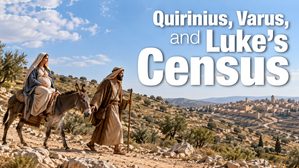
Quirinius, Varus, and Luke’s Census

It is widely known that the inspired biographer Luke related how Joseph, Mary, and the baby Jesus traveled to Bethlehem due to a Roman census: “Now in those days a decree went out from Caesar Augustus, that a census be taken of all the inhabited earth. This was the first census taken while Quirinius was governor of Syria” (Luke 2:1-2, NASB). While acknowledging that Publius Sulpicius Quirinius officially became governor of Syria in A.D. 6, about 10 years after the birth of Jesus, we have pointed out that critics of the Bible have failed to prove that Luke made a historical error.1 This includes the fact that Luke’s word translated “governor” is generic enough to make possible Quirinius’ oversight of the census even though he was not technically the governor.
Interestingly, our historical information about the official governor or legate of Syria at the time of Jesus’ birth provides additional support to the plausibility of Luke’s assertion that Quirinius, although not the official legate of Syria at the time, could have overseen a census.
Publius Quinctilius Varus’ Failure
Publius Quinctilius [sometimes spelled “Quintilius”] Varus (d. A.D. 9) was a Roman general whose father had been one of Julius Caesar’s assassins.2 Varus became the Roman governor of Syria in 7/6 B.C. and served until sometime after the death of Herod the Great in 4 B.C.3 The Roman historian Suetonius gives us insight into Caesar Augustus’ view of Varus, which was conditioned by Varus’ disastrous military loss (and suicide4):
[Augustus] suffered but two severe and ignominious defeats, those of Lollius and Varus, both of which were in Germany. Of these the former was more humiliating than serious, but the latter was almost fatal, since three legions were cut to pieces with their general, his lieutenants, and all the auxiliaries. When the news of this came, he ordered that watch be kept by night throughout the city, to prevent any outbreak, and he prolonged the terms of the governors of the provinces, that the allies might be held to their allegiance by experienced men with whom they were acquainted. They say that he was so greatly affected that for several months in succession he cut neither his beard nor his hair, and sometimes he would dash his head against a door, crying: “Quintilius Varus, give me back my legions!” And he observed the day of the disaster each year as one of sorrow and mourning.5
Granted, Varus’ military defeat to the Germanic tribes took place sometime after the census mentioned by Luke. Nonetheless, in Suetonius’ report we have a case in which Augustus directly questioned the leadership of the very person whose leadership is the lynchpin in a criticism of the historical accuracy of the Bible. Given Augustus’ displeasure with Varus, would it be surprising for him to have put Quirinius, of whom he plausibly had a favorable view,6 in charge of a census-enrollment that would have an impact on taxation?7
Luke’s remarkable accuracy as a historian should always motivate commentators to provide relevant evidence supporting possible explanations for what would otherwise be a glaring and uncharacteristic mistake.8
Endnotes
1 Dave Miller (2002), “Luke, Quirinius, and the Census,” Apologetics Press, https://apologeticspress.org/luke-quirinius-and-the-census-907/.
2 “Publius Quinctilius Varus,” Encyclopedia Britannica, https://www.britannica.com/biography/Publius-Quinctilius-Varus (n.d.).
3 Josephus, Antiquities of the Jews, 7:17.5,9.
4 Dio Cassius, Roman History, 7:56.21.5.
5 Suetonius, Lives of the Caesars, 1:23.
6 Tacitus, Annals, 1:3.48.
7 Josephus reports that Quirinius’ later census was for the purpose of assessing Jewish property (Antiquities of the Jews, 18:1.1). See the documentation in Wayne Brindle (1984), “The Census and Quirinius: Luke 2:2,” Journal of the Evangelical Theological Society,27[1]:50.
8 See Colin Hemer (1989), The Book of Acts in the Setting of Hellenistic History, ed. Conrad H. Gempf, Wissenschaftliche Untersuchungen zum Neuen Testament 49 (Tübingen: J. C. B. Mohr), chapters 4-5.

REPRODUCTION & DISCLAIMERS: We are happy to grant permission for this article to be reproduced in part or in its entirety, as long as our stipulations are observed.